


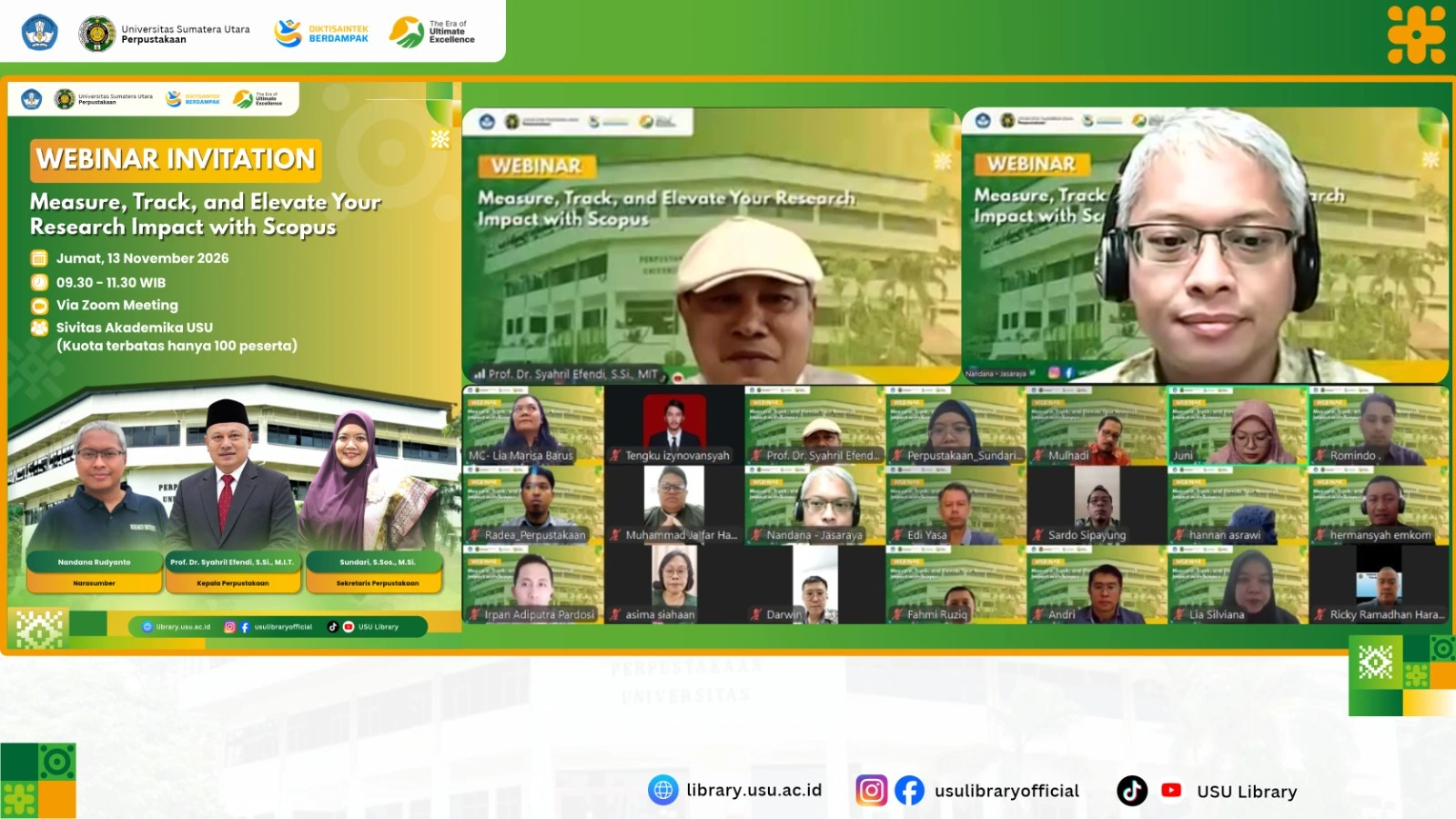
Medan, November 13, 2026 – The Library of Universitas Sumatera Utara (USU) successfully hosted a webinar entitled “Measure, Track, and Elevate Your Research Impact with Scopus” on Friday, November 13, 2026, via Zoom Meeting. The event was attended by 100 participants from the USU academic community, aiming to enhance their understanding and optimize the use of Scopus in supporting research activities and scholarly publications.
The webinar was officially opened by the Head of USU Library, Prof. Dr. Syahril Efendi, S.Si., M.I.T. The event was also attended by Sundari, S.Sos., M.Si., Secretary of USU Library, along with USU Library staff. The session was moderated by Lia Marisa Barus, S.I.Pust., Coordinator of Reference Services and Print Collection Organization at USU Library.
During the webinar, Nandana Rudyanto delivered a presentation on the use of Scopus as a scholarly literature database to support research development and improve the quality of academic publications.
Through Scopus, researchers can access reputable scholarly literature, identify research developments and trends, explore research collaboration opportunities, and monitor citation counts and the impact of scholarly publications. Scopus also provides various bibliometric metrics that can be used to analyze publication performance and measure research development and impact.
Universitas Sumatera Utara has subscribed to Scopus as part of the institution's commitment to improving the quality of education and research. Through this subscription, members of the USU academic community can access a wide range of scholarly literature to support literature searches, academic writing, research development, and enhance the visibility of academic publications.
This webinar represents one of USU Library's commitments to introducing and promoting the optimal use of electronic information resources subscribed to by the university. Through this initiative, members of the academic community are expected to gain a better understanding of Scopus features and benefits and make optimal use of this resource to support research productivity, development, and quality improvement at both national and international levels.